I used to blog about writing. I did a lot of it, actually, pouring so many words into craft articles that it’s a wonder I ever got a novel written.
It’s been more than four years since I blogged about writing. But now that I have a new platform via this website, I want to share more of my journey. If the past few years of my writing life has taught me anything, it’s that community is everything. It’s how this book—the book you’re about to see snippets of—got written with the help of group chat brainstorming and beta reading, but that’s another post for another day.
Anyway, I’m here to share a few things I’ve learned and create more community. Join me for writing updates and craft posts on a schedule completely subject to my schedule, energy, and inspiration.
Anyway, the line editing
I recently line edited my most recent YA fantasy novel. Have I worked as a professional copyeditor? Yes! Does this make line editing (or the process of turning a plot-intact novel into something with readable prose) easier? Absolutely not.
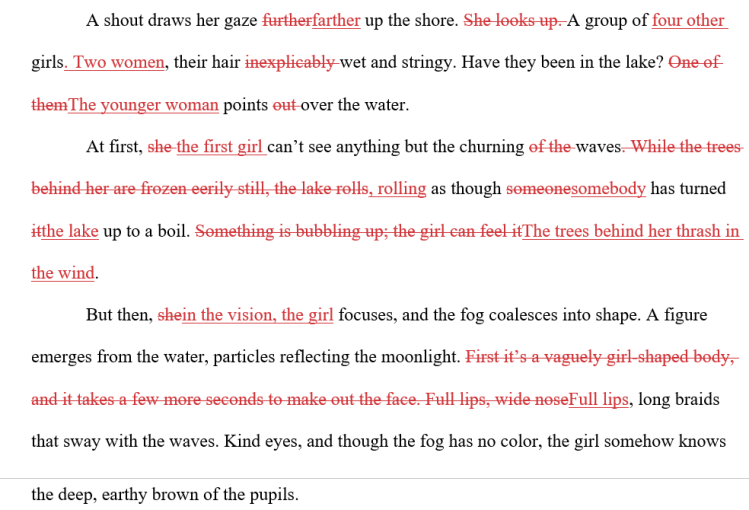
But sometimes, it’s helpful to dive into another writer’s process and learn about their line edits. (I owe so much to Maggie Stiefvater’s brilliant before-and-after posts). Now that I’ve recovered from the brain-slog of reading 75,000 of your own words with utmost care, I’ve selected two snippets to compare my own before and after. See the screenshot for inline edits, or the original/revised comparison below with explanations about each change, in the hopes that my thought process will help yours in some small way.
Snippet one
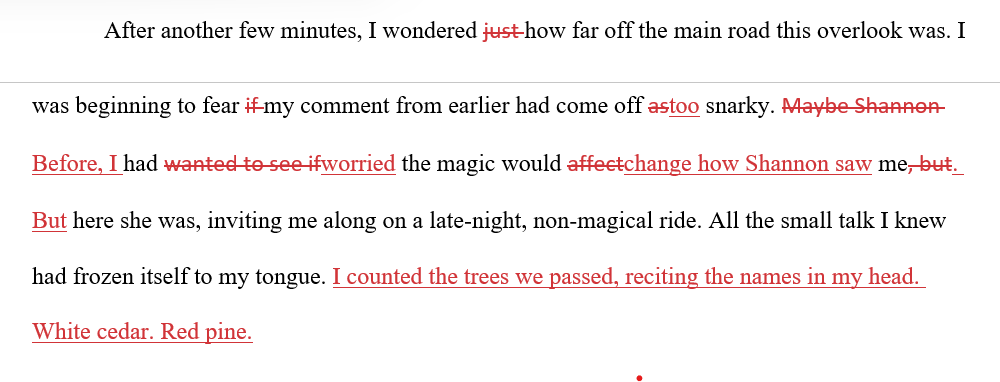
Original: After another few minutes, I wondered just how far off the main road this overlook was.(1) I was beginning to fear if my comment from earlier had come off as snarky.(2,3) Maybe Shannon had wanted to see if the magic would affect me, but here she was, inviting me along on a late-night, non-magical ride.(4) All the small talk I knew had frozen itself to my tongue.(5)
- Deleted “just.” Unnecessary word.
- Deleted “if.” Doesn’t make sense and reads fine without.
- Switched “as” to “too.” The sentence is snarky either way, but in the revision, it’s too snarky. I wanted my narrator’s value judgement to come through.
- Breaking one sentence into two. Originally, this sentence highlighted Miriam’s (the narrator’s) distrust of Shannon’s motives, but framed in Shannon’s feelings. The revised version focuses the emotion through Miriam’s gaze.
- Added a little more interiority from Miriam that hints at both an interest in botany and in her need to find a pattern to soothe her nerves.
Revised: After another few minutes, I wondered how far off the main road this overlook was. I was beginning to fear my comment from earlier had come off too snarky. Before, I had worried the magic would change how Shannon saw me. But here she was, inviting me along on a late-night, non-magical ride. All the small talk I knew had frozen itself to my tongue. I counted the trees we passed, reciting the names in my head. White cedar. Red pine.
Snippet two
Original:
A shout draws her gaze further(1) up the shore. She looks up.(2) A group of girls, their hair inexplicably wet and stringy.(3) Have they been in the lake? One of them points out over the water.(4)
At first, she can’t see anything but the churning of the waves.(5) While the trees behind her are frozen eerily still, the lake rolls as though someone has turned it up to a boil.(6) Something is bubbling up; the girl can feel it.(7)
But then, she focuses, and the fog coalesces into shape.(8) A figure emerges from the water, particles reflecting the moonlight. First it’s a vaguely girl-shaped body, and it takes a few more seconds to make out the face. Full lips, wide nose, long braids that sway with the waves.(9) Kind eyes, and though the fog has no color, the girl somehow knows the deep, earthy brown of the pupils.
- Fixing further/farther.
- Deleted; unnecessary. We already know she’s looking.
- Clarifying that these are other girls, separate from unnamed Girl/narrator.
- Also specifying that there are two women here.
- Clarifying again; deleting unnecessary “of the.” Also notice that I still have two “firsts” here. Remember, kids: Screenshotting your work will always reveal errors.
- The trees aren’t still; it later becomes relevant that this happens during a storm.
- Not sure what this means, and we already established the rolling, boiling lake.
- Clarifying point of view again.
- Trimmed to reduce redundancy of “girl-shaped body” and “figure.
Revised:
A shout draws her gaze farther up the shore. A group of four other girls. Two women, their hair wet and stringy. Have they been in the lake? The younger woman points over the water.
At first, the first girl can’t see anything but the churning waves, rolling as though somebody has turned the lake up to a boil. The trees behind her thrash in the wind.
But then, in the vision, the girl focuses, and the fog coalesces into shape. A figure emerges from the water, particles reflecting the moonlight. Full lips, long braids that sway with the waves. Kind eyes, and though the fog has no color, the girl somehow knows the deep, earthy brown of the pupils.
A few additional learnings from this round of line edits:
- “Something” is a draft word. My first drafts are full of sentences like “Something told her this wouldn’t end well” and “Something flashed in the reflection of his glasses.” Somethings are happening everywhere, but it’s vague. What flashed in the reflection? The something separates you from the action. What if it was “A sharp light flashed in the reflection of his glasses” or “A hint of red flashed in the reflection of his glasses”?
- In general, CTRL + F for your filler words. These are your maybes, your justs, your looked and glanced and whatever else goes on to get you through a first draft. (My characters are always like “part of me felt X.” Why are they always feeling in parts?) Don’t delete them all without consideration, but learn to notice when they’re a crutch.
- Dialogue and action: Is it clear who is saying what and who is doing what in each scene?
- Consistency check: I find it easiest to keep track of timing, character appearance details, and other common consistency problem spots as I go. For example, this book involved a student, but my character’s class schedule was all over the place. While editing, I made a note each time I mentioned a specific class/time of day/teacher, and at the end, did a quick pass to fix everything. It was easier for me, personally, than trying to fix it in the midst of all other edits.
- Don’t spend too much time on any one paragraph/sentence. It’s not that important. I promise.
What was your last line editing experience like?
Also, since we’re all new here: Keep up with me on Twitter and Instagram for more context on this novel and my writing world adventures.
 Anne Kopas